Showing posts with label ramzi aburedwan. Show all posts

Saturday, July 4, 2009

Al-Kamandjati Summer Camp 2009, al-Fara'a, the West Bank (part 2)

http://historyviolins.blogspot.com/2009/07/al-kamandjati-summer-camp-2009-al-faraa.html


The al-Kamandjati Summer Music Days camp came to a close a few days ago. As the camp went on we got a chance to see more and more of the students performing, which was wonderful.


I had a chance to interview Peter Sulski, the artistic director of the summer camp. Sulski started coming to the Middle East with the Apple Hill Chamber Players in 1996 and became Ramzi Aburedwan's teacher and friend. "It's been an incredible ride," he says about the experience.


"I think the summer camp is an incredible social opportunity to be around each other and to have lots of role models even for five full days.. to experience a real bump up in their growth. It's a chance for them to feel really legitimate in the field of music. As a student even in america you can feel outside the culture of music."


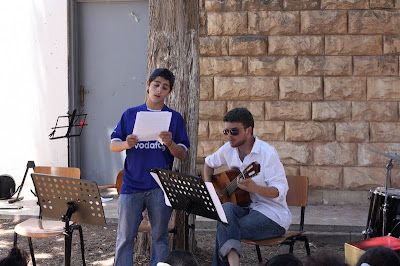
The first picture here is one of the students performing Dowland's "Flow my Teares".


One of the popular workshops was the oriental percussion workshop, which had 10-15 children performing on native Arab drums.


Ramzi Aburedwan, the founder of al-Kamandjati, plays oud and drums in addition to the viola; here is him performing for the children.


Robert "Dobbs" Hartshone has been coming to the West Bank for the last twenty years giving performances for children here, as he does around the world in other places like Afghanistan. He performed a Bach cello suite and a narrated piece in Arabic about a beaver that falls in love with a tree. The kids loved it.


The final concert was very long and had performances by nearly every child. The orchestra performed a arrangement of the slow movement from Beethoven's 7th Symphony.


The last piece was a song from Pink Floyd's album "The Wall."


The experience was very educational for the teachers as well. Drew Balch, a native of London and the viola teacher, talked about his experiences with the people here. "It's the one thing you can't really be told in stories in the media. Now I've met these people face to face, heard their stories and I've become involved in their stories now, and it's just so much more real."


Wednesday, June 10, 2009

"We were a foreign body entering the Old City." An interview with the executive director of Al-Kamandjati

Celine Dagher, Executive Director of the al-Kamandjati, has been associated with the music school since 2005 when she moved to Ramallah. The wife of al-Kamandjati founder Ramzi Abuderwan, she is also a brand new mother; she gave birth to a boy, Hussein Abuderwan, last night.

Her duties at al-Kamandjati include the overall administration of the school, not limited to coordinating teachers, fundraising, public relations, contacts with other music assocations, and links abroad. Efficient coordination is essential given the breadth of the school's work, as it operates in three refugee camps- Al-Amari, Jalazoon, and Qalandia- as well as various villages and cities, such as Jenin, Tulkarem, and Deir Ghassaneh.


She first met Ramzi at a 2005 concert in France featuring his band. She read some information on the organization, which he founded in France in 2002, and joined with him as they made the move to Ramallah. "Seeing the truck arrive with two tons of instruments was the most exciting part," she says. "As well as seeing the center being built from empty walls to a music school."

The initial reception from the Palestinian community was very positive, she says. "Before we founded the school we spent a lot of time making workshops and concerts across the West Bank. It helped us build links with communities and existing institutions and let them get to know us better."

Dagher says the initial reaction to the opening of the school was curiosity and enthusiasm. "We were a foreign body entering the Old City of Ramallah, which is a very close place where everyone knows each other." But people quickly became used to it. "Children began to come to the school just because they were interested and wanted to see."

Attracting students was a very natural process and required very little additional advertising or campaigning. "At the beginning the children would enroll themselves because they were so interested." So many students were interested that there is now a waiting list of 600 children waiting to receive instruction at the school.

I asked her about the arson in the al-Kamandjati center in Jenin, which gutted the building and made international news. The center was quickly repainted and reopened. "It was disappointing. All of our students there are very motivated and dedicated, and it was hard to understand why it happened." But she says that they never believed that it was an expression of community disapproval. "We only think it was the work of individuals."

I asked her to briefly touch on the relationship with the school to Israel. "There seems to be a communication wall between what happens here and in Israel. I don't think so many people in Israel are aware of us, compared to those abroad."

I finally asked her about what she thinks about al-Kamandjati in the broader social context of Palestine. "I like to present al-Kamandjati as a music school, and it will bring what music will bring to any child. We are in the special context of occupation, and it might bring more to a child here than elsewhere. I think if you talk to the children here they might say that music gives them a lot of power, and it helps them to be proud of their identity and culture.

"We live next to our students and see them daily. It is very rewarding to see how they change and evolve."