Showing posts with label classical music. Show all posts

Tuesday, July 14, 2009

"We are Muslims. God created us to have good lives, not to stop it." Wafa Younis, music teacher and conductor

http://historyviolins.blogspot.com/2009/07/we-are-muslims-god-created-us-to-have.html

I was in the Jenin Refugee Camp sitting with a group of children, waiting for the arrival of their music teacher, Wafa Younis. As the taxi pulled up the children sprang up and ran towards it, yelling and laughing, waiting for their turn to hug and greet her. "This is my family, here in the Jenin Camp," Wafa explained to me. "I love them so much and they love me back."


Wafa was recently a reluctant star in the international news after her group from Jenin gave a short performance to a group of elderly Holocaust survivors in Holon, Israel. The performance caused turmoil in the Jenin Camp that resulted in the local leadership temporarily shutting down her student group. "When a newswriter from Jenin called me to tell me that there was a problem I laughed," she said. "I made no mistake. They are old people we played for. I am not playing music for (Israeli defense minister) Ehud Barak or (Israeli President) Shimon Peres. But I am ready to play music for people in pain."

Wafa grew up in Israel in the Arab village of 'Ara, and went to high school in Haifa, where she was the only Arab studying amongst Jews. After graduating she became a music teacher, the first in the Wadi 'Ara (the area surrounding the village). During the early years she worked with 40 children in a class for eight hours a day. "My head hurt a lot," she says.

In March 2003, a suicide bombing in the Haifa restaurant "Mattsa" took the life of the husband of a Jewish friend, Paula Yeroshalmy. "I can't tell you how strong the relationship between me and her is. It was such a tragedy."

Wafa learned that the suicide bomber came from the Jenin Camp, and decided that she would begin building a school here. "We are Muslims. God created us to have good lives, not to stop it. It wasn't like this in all the history of Islam."

"We Palestinians want our country. We have to fight for it, but not by taking lives. We can do it through music, talks, meetings, but not bombing."

She spent 40,000 dollars of her own money on the project after receiving no help from either the Israelis or Palestinians. After building the orchestra and putting on concerts inside Israel she received more attention and was able to receive donations of violins from private donors and universities. She now teaches 40 children in the Jenin Refugee Camp as part of her orchestra, "Strings of Freedom." Continuing to run the group is a difficult task, as she explains, given the difficulties of funding for renting space for rehearsals and acquiring new violins in addition. There is little money left, she says.

Wafa has also been working on three books for children. One of them, "Children for Peace," interviews 60 children, including Palestinian children in Israeli jails, about their thoughts on peace in the region. Another is a book of songs in Hebrew and Arabic, and she was able to get permission from Yoko Ono to use a Beatles song in it. The last contains musical settings of poetry written by Palestinian poets, "None of the poetry talks badly about Israel," she says. "They just reflect on their sadness on losing their homes and land."

Her immediate plans for the future involve building up the orchestra, which she needs new violins for. In the long-term she hopes to build a music academy in Jenin. "I want these children to be the first Palestinian music teachers in the West Bank," she says. Convincing the PA Minister of Education to mandate music teaching in Palestinian schools is a part of her mission.

"It bothers me so much that Israel says that the Palestinians are terrorists. I have been here in Jenin for seven years. I want to tell the world that the truth is not being told. Jenin isn't just Kalishnakovs. It is music as well."


Saturday, July 4, 2009

Al-Kamandjati Summer Camp 2009, al-Fara'a, the West Bank (part 2)

http://historyviolins.blogspot.com/2009/07/al-kamandjati-summer-camp-2009-al-faraa.html


The al-Kamandjati Summer Music Days camp came to a close a few days ago. As the camp went on we got a chance to see more and more of the students performing, which was wonderful.


I had a chance to interview Peter Sulski, the artistic director of the summer camp. Sulski started coming to the Middle East with the Apple Hill Chamber Players in 1996 and became Ramzi Aburedwan's teacher and friend. "It's been an incredible ride," he says about the experience.


"I think the summer camp is an incredible social opportunity to be around each other and to have lots of role models even for five full days.. to experience a real bump up in their growth. It's a chance for them to feel really legitimate in the field of music. As a student even in america you can feel outside the culture of music."


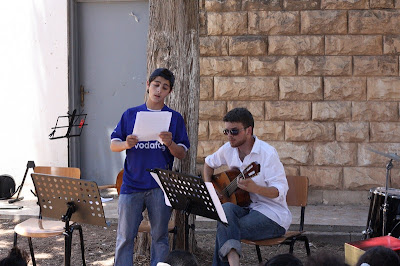
The first picture here is one of the students performing Dowland's "Flow my Teares".


One of the popular workshops was the oriental percussion workshop, which had 10-15 children performing on native Arab drums.


Ramzi Aburedwan, the founder of al-Kamandjati, plays oud and drums in addition to the viola; here is him performing for the children.


Robert "Dobbs" Hartshone has been coming to the West Bank for the last twenty years giving performances for children here, as he does around the world in other places like Afghanistan. He performed a Bach cello suite and a narrated piece in Arabic about a beaver that falls in love with a tree. The kids loved it.


The final concert was very long and had performances by nearly every child. The orchestra performed a arrangement of the slow movement from Beethoven's 7th Symphony.


The last piece was a song from Pink Floyd's album "The Wall."


The experience was very educational for the teachers as well. Drew Balch, a native of London and the viola teacher, talked about his experiences with the people here. "It's the one thing you can't really be told in stories in the media. Now I've met these people face to face, heard their stories and I've become involved in their stories now, and it's just so much more real."


Sunday, June 28, 2009

Al-Kamandjati Summer Camp 2009, al-Fara'a, the West Bank (part 1)

http://historyviolins.blogspot.com/2009/06/al-kamandjati-summer-camp-2009-al-faraa.html

One of the seminal teaching events for al-Kamandjati of the year is their summer camp, which is a seven-day music festival for their students around the West Bank. Due to the difficulties of moving students from one town to another, this is a chance for all the students to meet and perform with each other. The camp is taking place in the village of al-Fara'a, close to the city of Nablus.


The mornings involve private lessons for all the students. Many volunteer teachers from all over the world came to teach in the summer camp on various instruments.


There are two orchestras in the camp; a junior orchestra made up of string students, and a full orchestra made up of the more advanced players.


Here's me teaching clarinet to one of my students. I'm also teaching composition to a few students; for the younger ones I am teaching them basic writing skills and for the older ones I'm trying to introduce them to counterpoint and tonal harmony.


During the afternoons we have a choir session where the students can all sing together. This is us right before we all sang a song by the famous Arab singer Fayrouz. We also have afternoon outdoor concerts made of up performances by children and faculty.


During the afternoon they have several workshops they can get involved in, including composition, notation, improvisation, and so on.


It's really interesting to see how contemporary classical music is fitting into this; we're doing this piece called "Self-Portrait" which involves a set of boxes on stage with notes on them; it's a bit hard to explain. We're also doing Riley's "In C" and Reich's "Clapping Music."


Here's the improvisation workshop. The children took to it really quickly!


There are also small chamber groups involved in performances.


One of the centerpieces of the al-Kamandjati program is the Oriental Ensemble, a group of performers playing on native Palestinian instruments. The group has been essential in bridging the gap between Western classical music and Palestinians; it was interesting to see that they teach the children Palestinian songs in solfege. Here's them performing at one of the nightly concerts.


The faculty is involved with performances- here's a few playing the Mozart Flute Quartet.


More next time.

Monday, June 15, 2009

Edward Said Conservatory Summer Camp- Birzeit

http://historyviolins.blogspot.com/2009/06/edward-said-conservatory-summer-camp.html

I'm a little drained to do a fuller writeup on what I've seen and heard from the Edward Said National Conservatory of Music so I will try and do so tomorrow. But I visited their three-day summer camp, which is taking place in Birzeit, a village a few kilometers from Ramallah. I wanted to post a few pictures, because it's quite amazing and the people there are great.


The mural outside the school is incredible. I really need to get a bigger camera lens.


The summer camp is an orchestra program; they're doing arrangements of the William Tell Overture and Finlandia.


They have a larger summer camp in July so hopefully I will be able to see more of them.

Wednesday, June 10, 2009

"We were a foreign body entering the Old City." An interview with the executive director of Al-Kamandjati

Celine Dagher, Executive Director of the al-Kamandjati, has been associated with the music school since 2005 when she moved to Ramallah. The wife of al-Kamandjati founder Ramzi Abuderwan, she is also a brand new mother; she gave birth to a boy, Hussein Abuderwan, last night.

Her duties at al-Kamandjati include the overall administration of the school, not limited to coordinating teachers, fundraising, public relations, contacts with other music assocations, and links abroad. Efficient coordination is essential given the breadth of the school's work, as it operates in three refugee camps- Al-Amari, Jalazoon, and Qalandia- as well as various villages and cities, such as Jenin, Tulkarem, and Deir Ghassaneh.


She first met Ramzi at a 2005 concert in France featuring his band. She read some information on the organization, which he founded in France in 2002, and joined with him as they made the move to Ramallah. "Seeing the truck arrive with two tons of instruments was the most exciting part," she says. "As well as seeing the center being built from empty walls to a music school."

The initial reception from the Palestinian community was very positive, she says. "Before we founded the school we spent a lot of time making workshops and concerts across the West Bank. It helped us build links with communities and existing institutions and let them get to know us better."

Dagher says the initial reaction to the opening of the school was curiosity and enthusiasm. "We were a foreign body entering the Old City of Ramallah, which is a very close place where everyone knows each other." But people quickly became used to it. "Children began to come to the school just because they were interested and wanted to see."

Attracting students was a very natural process and required very little additional advertising or campaigning. "At the beginning the children would enroll themselves because they were so interested." So many students were interested that there is now a waiting list of 600 children waiting to receive instruction at the school.

I asked her about the arson in the al-Kamandjati center in Jenin, which gutted the building and made international news. The center was quickly repainted and reopened. "It was disappointing. All of our students there are very motivated and dedicated, and it was hard to understand why it happened." But she says that they never believed that it was an expression of community disapproval. "We only think it was the work of individuals."

I asked her to briefly touch on the relationship with the school to Israel. "There seems to be a communication wall between what happens here and in Israel. I don't think so many people in Israel are aware of us, compared to those abroad."

I finally asked her about what she thinks about al-Kamandjati in the broader social context of Palestine. "I like to present al-Kamandjati as a music school, and it will bring what music will bring to any child. We are in the special context of occupation, and it might bring more to a child here than elsewhere. I think if you talk to the children here they might say that music gives them a lot of power, and it helps them to be proud of their identity and culture.

"We live next to our students and see them daily. It is very rewarding to see how they change and evolve."