Showing posts with label al-kamandjati. Show all posts

Friday, July 24, 2009

Birth of a Palestinian Violin

Shehade Shalade's road to becoming the first Palestinian violinmaker is maybe an unlikely one. Living in a region where classical music is small but rapidly growing, Shehade, 18, was fortunate to have the al-Kamandjati music school established next door to his house in Ramallah in the West Bank. "I had always been interested in fixing things, like doors, windows and chairs," he says. Ramzi Aburedwan, the founder of al-Kamandjati, saw Shehade's potential and asked him if he would like to work with musical instruments.

Shehade was at first interested in the oud, a Arabic plucked instrument similar to the guitar, and later moved to violin. He concurrently started working in the workshop that al-Kamandjati set up for instrument repair a few meters away from the school. Al-Kamandjati is fortunate to have a large amount of foreign expertise coming to assist the school, and Shehade was able to study with technicians who taught him how to repair string instruments and bows.

In 2008 his teacher, Gianlucco Negroponte, advised him to study in Italy in order to learn the art of violinmaking. Shehade began studying in Italy in July and by September had finished his first violin, which he uses himself. "It was difficult but I was so happy when I finished. Palestine has never had a violin-maker before."


Shehade has recently been working on a second violin, which he will give to Ramzi to showcase around Europe. He has been working on this model for a month, and will need about two more weeks before it is completed.


In September Shehade will be going to London to study instrument making for three years. Afterward he plans to come back to Palestine and teach children here violinmaking and instrument repair.

I asked him what the community around him thinks of his work. "At first they were hesitant. Nobody does something like this here, doing this type of job. I told them that I want to try, because it is something I love."


Saturday, July 4, 2009

Al-Kamandjati Summer Camp 2009, al-Fara'a, the West Bank (part 2)

http://historyviolins.blogspot.com/2009/07/al-kamandjati-summer-camp-2009-al-faraa.html


The al-Kamandjati Summer Music Days camp came to a close a few days ago. As the camp went on we got a chance to see more and more of the students performing, which was wonderful.


I had a chance to interview Peter Sulski, the artistic director of the summer camp. Sulski started coming to the Middle East with the Apple Hill Chamber Players in 1996 and became Ramzi Aburedwan's teacher and friend. "It's been an incredible ride," he says about the experience.


"I think the summer camp is an incredible social opportunity to be around each other and to have lots of role models even for five full days.. to experience a real bump up in their growth. It's a chance for them to feel really legitimate in the field of music. As a student even in america you can feel outside the culture of music."


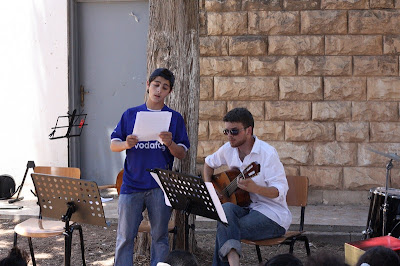
The first picture here is one of the students performing Dowland's "Flow my Teares".


One of the popular workshops was the oriental percussion workshop, which had 10-15 children performing on native Arab drums.


Ramzi Aburedwan, the founder of al-Kamandjati, plays oud and drums in addition to the viola; here is him performing for the children.


Robert "Dobbs" Hartshone has been coming to the West Bank for the last twenty years giving performances for children here, as he does around the world in other places like Afghanistan. He performed a Bach cello suite and a narrated piece in Arabic about a beaver that falls in love with a tree. The kids loved it.


The final concert was very long and had performances by nearly every child. The orchestra performed a arrangement of the slow movement from Beethoven's 7th Symphony.


The last piece was a song from Pink Floyd's album "The Wall."


The experience was very educational for the teachers as well. Drew Balch, a native of London and the viola teacher, talked about his experiences with the people here. "It's the one thing you can't really be told in stories in the media. Now I've met these people face to face, heard their stories and I've become involved in their stories now, and it's just so much more real."


Sunday, June 28, 2009

Al-Kamandjati Summer Camp 2009, al-Fara'a, the West Bank (part 1)

http://historyviolins.blogspot.com/2009/06/al-kamandjati-summer-camp-2009-al-faraa.html

One of the seminal teaching events for al-Kamandjati of the year is their summer camp, which is a seven-day music festival for their students around the West Bank. Due to the difficulties of moving students from one town to another, this is a chance for all the students to meet and perform with each other. The camp is taking place in the village of al-Fara'a, close to the city of Nablus.


The mornings involve private lessons for all the students. Many volunteer teachers from all over the world came to teach in the summer camp on various instruments.


There are two orchestras in the camp; a junior orchestra made up of string students, and a full orchestra made up of the more advanced players.


Here's me teaching clarinet to one of my students. I'm also teaching composition to a few students; for the younger ones I am teaching them basic writing skills and for the older ones I'm trying to introduce them to counterpoint and tonal harmony.


During the afternoons we have a choir session where the students can all sing together. This is us right before we all sang a song by the famous Arab singer Fayrouz. We also have afternoon outdoor concerts made of up performances by children and faculty.


During the afternoon they have several workshops they can get involved in, including composition, notation, improvisation, and so on.


It's really interesting to see how contemporary classical music is fitting into this; we're doing this piece called "Self-Portrait" which involves a set of boxes on stage with notes on them; it's a bit hard to explain. We're also doing Riley's "In C" and Reich's "Clapping Music."


Here's the improvisation workshop. The children took to it really quickly!


There are also small chamber groups involved in performances.


One of the centerpieces of the al-Kamandjati program is the Oriental Ensemble, a group of performers playing on native Palestinian instruments. The group has been essential in bridging the gap between Western classical music and Palestinians; it was interesting to see that they teach the children Palestinian songs in solfege. Here's them performing at one of the nightly concerts.


The faculty is involved with performances- here's a few playing the Mozart Flute Quartet.


More next time.

Tuesday, June 23, 2009

Concert in the al-Amari Refugee Camp

http://historyviolins.blogspot.com/2009/06/concert-in-al-amari-refugee-camp.html

I had originally planned to do a bigger report but that will have to wait until later. Yesterday the teachers of al-Kamandjati gave a concert in the al-Amari Refugee Camp, which is walking distance from the school. Like many refugee camps, al-Amari suffers from overcrowding and poor services; and like poorer areas in general it has a high birthrate and a large number of children.


Ramzi Aburedwan, the founder of the al-Kamandjati school, is himself a native of the al-Amari camp. He was lucky enough to be able to study violin at the Edward Said National Conservatory, which led to more training in France. After al-Kamandjati was set up in Ramallah he installed an auxillary school in al-Amari where teachers can train refugee children as well as give performances.

The concert was packed with children, many of whom have little to do during the summer months. Here are a few pictures.


Wednesday, June 10, 2009

"We were a foreign body entering the Old City." An interview with the executive director of Al-Kamandjati

Celine Dagher, Executive Director of the al-Kamandjati, has been associated with the music school since 2005 when she moved to Ramallah. The wife of al-Kamandjati founder Ramzi Abuderwan, she is also a brand new mother; she gave birth to a boy, Hussein Abuderwan, last night.

Her duties at al-Kamandjati include the overall administration of the school, not limited to coordinating teachers, fundraising, public relations, contacts with other music assocations, and links abroad. Efficient coordination is essential given the breadth of the school's work, as it operates in three refugee camps- Al-Amari, Jalazoon, and Qalandia- as well as various villages and cities, such as Jenin, Tulkarem, and Deir Ghassaneh.


She first met Ramzi at a 2005 concert in France featuring his band. She read some information on the organization, which he founded in France in 2002, and joined with him as they made the move to Ramallah. "Seeing the truck arrive with two tons of instruments was the most exciting part," she says. "As well as seeing the center being built from empty walls to a music school."

The initial reception from the Palestinian community was very positive, she says. "Before we founded the school we spent a lot of time making workshops and concerts across the West Bank. It helped us build links with communities and existing institutions and let them get to know us better."

Dagher says the initial reaction to the opening of the school was curiosity and enthusiasm. "We were a foreign body entering the Old City of Ramallah, which is a very close place where everyone knows each other." But people quickly became used to it. "Children began to come to the school just because they were interested and wanted to see."

Attracting students was a very natural process and required very little additional advertising or campaigning. "At the beginning the children would enroll themselves because they were so interested." So many students were interested that there is now a waiting list of 600 children waiting to receive instruction at the school.

I asked her about the arson in the al-Kamandjati center in Jenin, which gutted the building and made international news. The center was quickly repainted and reopened. "It was disappointing. All of our students there are very motivated and dedicated, and it was hard to understand why it happened." But she says that they never believed that it was an expression of community disapproval. "We only think it was the work of individuals."

I asked her to briefly touch on the relationship with the school to Israel. "There seems to be a communication wall between what happens here and in Israel. I don't think so many people in Israel are aware of us, compared to those abroad."

I finally asked her about what she thinks about al-Kamandjati in the broader social context of Palestine. "I like to present al-Kamandjati as a music school, and it will bring what music will bring to any child. We are in the special context of occupation, and it might bring more to a child here than elsewhere. I think if you talk to the children here they might say that music gives them a lot of power, and it helps them to be proud of their identity and culture.

"We live next to our students and see them daily. It is very rewarding to see how they change and evolve."

Sunday, June 7, 2009

What happens when your clarinet breaks in Mozambique?

http://historyviolins.blogspot.com/2009/06/what-happens-when-your-clarinet-breaks.html

For budding musicians in developing regions, acquiring an instrument only goes so far. Eventually its keys or valves will become stiff, strings will break and leaks will develop. This is in addition to the inevitable acciden
Publish Post
ts that will occur in a child's hands. For many children around the world, this damage can be devastating if there are no replacement parts and qualified technicians in the vicinity to help with repairs. This is where people like Pierre Helou come in.

Helou is a native of France and is employed by The Music Fund, a Belgian non-governmental organization that provides instrument repair services and new instruments to children in partner schools located in the West Bank, Mozambique, and the Democratic Republic of the Congo.

Helou at work on one of al-Kamandjati's oboes

After we discussed the condition of the oboes at al-Kamandjati, I was able to talk with him about the general nature of his work.

Helou has been in the employ of The Music Fund for the last year. During his vacation time he has travelled to Ramallah in the West Bank and Kinshasa in the Democratic Republic of the Congo. An instrumental technician for seven years with a speciality in wind instruments, he has seen the difficulties that music programs in developing regions face.

"At the school in Kinshasa they had no workshop for repairing wind instruments," he explained. "So we had to install and develop a new workshop there."

The biggest issue for repairing instruments in the areas that he works in is a lack of viable equipment. "Corks and pads wear easily over time and need to be replaced regularly. They can be difficult to find in places."

Helou noted the differences between working in Kinshasa and Ramallah. "With al-Kamandjati in Ramallah we have a running workshop so the work becomes much easier. The trick is making do with what you have in the place you are."

Friday, June 5, 2009

...denn ihre Werke folgen ihnen nach

http://historyviolins.blogspot.com/2009/06/denn-ihre-werke-folgen-ihnen-nach.html

The first major project of the summer for al-Kamandjati is the Summer Music Days Festival, in which they are putting on 100(!) concerts of classical all across the West Bank in 10(!) days. The Choir of London will be coming as guests to Ramallah, and they will combine with a group of Palestinians to sing Brahms's German Requiem. Quite a few of the vocalist students in al-Kamandjati are involved in this; as anyone who knows about classical music would realize the fact that any teenager can keep up with this piece is remarkable!


I was invited by the singing teacher at al-Kamandjati, Julia, to go to the rehearsal of the piece at Bethlehem University in Bethlehem. Instead of just standing there recording the rehearsal and taking pictures I decided to sing along with the bass part, which turned out to be fine because the rest of the choir was sight-reading as well. The priest leading the choir agreed to let me do an interview with him next week so I could get more details on his history with the choir.


I will also be performing the Vaughan Williams songs for oboe and soprano, and maybe other pieces. The last few days have also been spent reorganizing the library, and I found that it is amazingly extensive; all the major pieces of the solo repertoire for all instruments are present as well as a huge number of orchestra pieces. I'm continually impressed with the resources of al-Kamandjati and the way that they are able to operate.

I have a few interviews coming up in the next few days which I will post writeups of as they happen.

Tuesday, June 2, 2009

Yara Qwareeq

http://historyviolins.blogspot.com/2009/06/yara-qwareeq-al-kamandjati-music-school.html

Like other students at the al-Kamandjati music school in Ramallah, Yara Qwareeq arrives for her weekly lesson and recieves a regimen of instruction in scales, finger technique, and other piano essentials. However, Yara is unique in a very particular way: she is completely blind.

Yara (center), teacher Grassi (left), mother Samahir (right)


Yara is one of 300 music students across the West Bank receiving instruction from the al-Kamandjati music school, one of the few serving Palestinian students. Giacomo Grassi, her teacher of eight months, said that the initial challenge was to orient Yara to the sound of the keyboard. "At the beginning it was especially important to get her to hear the sound of octaves, fourths and fifths." Then came work with rhythmic imitation, and differentiating between black and white keys.

A typical lesson for Yara involves a great deal of imitation, as Grassi plays out rhythmic patterns or scales and she follows. To learn technique she places her hand on top of Grassi's in order to conceptualize its shape. She is also allowed to improvise melodies over harmonies played by Grassi; an exercise that she particularly enjoys.

From a young age she developed a proclivity towards music, says her mother, Samahir. "From the time she was a baby she used to sing along with famous songs in Arabic and English. I hope that I can develop her power to sing through the piano."